WHAT IS A FEIJOA?
A feijoa is an egg-sized green fruit with a sweet, floral, tropical flavour. It is also sold as pineapple guava.
Feijoa (Feijoa sellowiana, also written Acca sellowiana) grows on an evergreen shrub or small tree in the myrtle family. The fruit is about the size of a chicken egg and ripens in autumn, from March to June in New Zealand. It is native to the highlands of southern Brazil, Uruguay, Colombia, northern Argentina and Paraguay, and it is not a true guava. Feiolix® is made from New Zealand feijoas.
HOW DO YOU PRONOUNCE FEIJOA?
In New Zealand, feijoa is usually pronounced “fee-jo-uh” or “fay-jo-uh” with an English ‘J’ sound.
The fruit is named after João da Silva Feijó, a Portuguese naturalist. In Portuguese the name sounds closer to “fay-ZHOH-uh”, and in Spanish it is “fay-HOH-uh”.
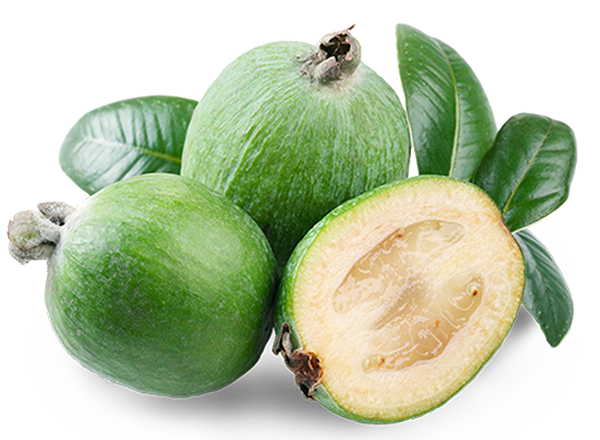
botanical name = Acca sellowiana or Feijoa sellowiana
FEIOLIX® IS MADE FROM THE WHOLE FEIJOA, INCLUDING THE SKIN.
Read about Feiolix whole-fruit feijoa powder
FEIJOAS IN NEW ZEALAND
Feijoas have been widely grown in New Zealand since the 1920s, and many Kiwi gardens have a tree or two. The fruit falls to the ground when ripe, and ripe fruit bruises easily, which is why feijoas are not exported often and are mostly eaten close to where they grow.
The usual way to eat one is to cut it in half and scoop out the jelly-like flesh with a spoon. The skin is edible, though many people leave it.
WHAT DOES A FEIJOA TASTE LIKE?
Feijoa is sweet and slightly tart, with a strong, floral, perfume-like aroma. People describe the taste as a mix of pineapple, banana, mint, strawberry and guava. The pulp around the seeds is juicy and jelly-like, and the flesh nearer the skin is firmer and slightly gritty.
FEIJOA NUTRITION
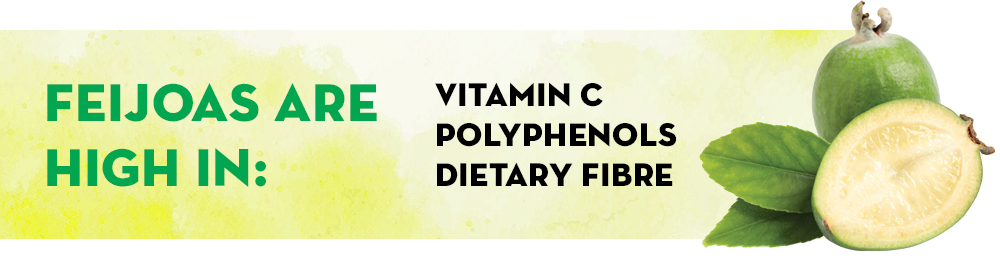
Feijoa is a high-fibre fruit with a good amount of vitamin C. The edible peel holds more flavonoids and vitamin C than the pulp (Phan et al., Foods, 2019), which is one reason Feiolix® is made from the whole fruit. Full numbers are in the table below.
Feiolix farm to gate story
WHERE DO FEIJOAS COME FROM?
Feijoa is native to the highlands of southern Brazil, Uruguay, Colombia, northern Argentina and Paraguay. The genus is named after João da Silva Feijó, a Portuguese naturalist. In 1890 Professor Edouard André introduced the plant from Uruguay to France, and those plants were the source of the seedlings that reached California and later New Zealand. Today the main growing areas are New Zealand, the United States (especially California) and Colombia.
FEIJOA OR PINEAPPLE GUAVA?
They are the same fruit. Feijoa is the usual name in New Zealand, and pineapple guava is common in the United States. Other names include fig guava and guavasteen. It is not a true guava, although both belong to the myrtle family.
HOW TO GROW AND STORE FEIJOAS
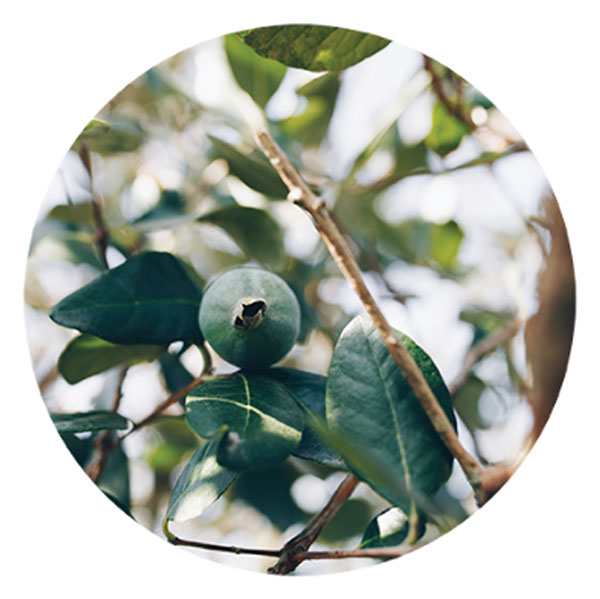
Feijoa grows as an evergreen shrub or small tree, 1 to 7 metres tall. It is a warm-temperate to subtropical plant that tolerates frost and partial shade, needs at least 50 hours of winter chilling to fruit, and wants regular watering while the fruit matures. Winter temperatures below about -9 °C can kill the flower buds, and summer heat above 32 °C can reduce fruit set.
Some grafted varieties are self-fertile, but most need a pollinator, so planting a second variety nearby is the safer choice. Bees, bumblebees and some birds pollinate the flowers. Grown from seed, young plants are slow for the first year or two.
Ripe fruit bruises easily. Feijoas can be cool-stored for about a month and frozen for up to a year without losing quality. Besides eating them raw, people use them in sorbet, pies, crumbles and salads.
IS FEIJOA GOOD FOR YOU?
Raw feijoa is a high-fibre fruit. At 6.4 g per 100 g it is above the 6 g per 100 g the EU uses for a “high fibre” claim, and the 32.9 mg of vitamin C is roughly 40% of the EU reference intake of 80 mg.
| Raw feijoa, per 100 g | Amount |
|---|---|
| Energy | 61 kcal |
| Water | 83.3 g |
| Dietary fibre | 6.4 g |
| Vitamin C | 32.9 mg |
| Folate | 23 µg |
| Potassium | 172 mg |
Source: USDA FoodData Central, “Feijoa, raw” (SR Legacy, FDC ID 168176).
WHAT DOES THE RESEARCH ON FEIJOA POWDER SHOW?
Fruit nutrition and a powder studied in people are separate questions. Feiolix® whole-fruit feijoa powder was tested in FERDINAND, a 6-month randomised, double-blind, placebo-controlled trial at the University of Auckland in 97 adults with overweight or obesity and prediabetes, taking 1,150 mg a day. Body weight and fasting glucose did not differ significantly from placebo. Systolic blood pressure was lower with Feiolix at 4 and 6 months, though the authors note the effect may be driven by participants with hypertension (Mohamed et al., Diabetes, Obesity and Metabolism, 2026). The trial tested the powder, not fresh fruit.
The full results and what they mean for product developers are on the Feiolix science page and the Feiolix feijoa powder page.
FEIJOA QUESTIONS, ANSWERED
What is a feijoa?
A feijoa is an egg-sized green fruit that grows on an evergreen shrub or small tree in the myrtle family. It has a thin, slightly bumpy skin, juicy jelly-like pulp and a sweet, slightly tart, floral flavour. It is native to the highlands of South America and widely grown in New Zealand, where it ripens in autumn.
How do you pronounce feijoa?
In New Zealand, feijoa is usually said “fee-JOH-uh” or “fay-JOH-uh”, with an English J. The fruit is named after João da Silva Feijó, a Portuguese naturalist, and in Portuguese the name sounds closer to “fay-ZHOH-uh”. In Spanish the J becomes an H sound, so you will also hear “fay-HOH-uh”.
Is a feijoa the same as a pineapple guava?
Yes. Feijoa and pineapple guava are two common names for the same fruit, Feijoa sellowiana, also written Acca sellowiana. Feijoa is the usual name in New Zealand, while pineapple guava is common in the United States. It is also called fig guava, but it is not a true guava, even though both belong to the myrtle family.
What does a feijoa taste like?
A feijoa tastes sweet and slightly tart, with a strong floral, perfume-like aroma. People describe a mix of pineapple, banana, mint, strawberry and guava. The pulp around the seeds is juicy and jelly-like, while the flesh nearer the skin is firmer and slightly gritty. The aroma comes mainly from methyl benzoate and related compounds.
Can you eat feijoa skin, and how do you eat a feijoa?
The usual way is to cut a feijoa in half and scoop out the pulp with a spoon. The skin is edible, though many people prefer to leave it, and the flower petals are edible too. Feijoas also go into sorbet, pies, crumbles and salads, and ripe fruit can be frozen for up to a year.
When are feijoas in season?
In New Zealand the feijoa season runs from March to June. The fruit ripens in autumn and falls to the ground when ripe, and it can also be picked slightly early to avoid bruising. In the Northern Hemisphere the fruit ripens in the autumn months there. Ripe feijoas bruise easily, so they are mostly sold close to where they grow.
Is feijoa good for you?
Raw feijoa is a high-fibre fruit, with 6.4 g of fibre and 32.9 mg of vitamin C per 100 g and 61 calories (USDA FoodData Central). Studies of the powder are a separate question: in a 6-month randomised trial of Feiolix, body weight and fasting glucose did not differ from placebo, while systolic blood pressure was lower.
Brands and manufacturers looking to formulate with feijoa powder can find supply partners through Anagenix’s distributor network.