
What Is a Feijoa? The Complete Guide to New Zealand’s Favourite Backyard Fruit
If you’ve ever spotted an egg-shaped green fruit at the farmers’ market and wondered what it was, or grown up with a tree of them in the backyard every autumn, you’ve met the feijoa. It’s one of the most under-recognised fruits in the world for how good it actually is, and outside New Zealand, most people have never heard of it, or know it by a different name entirely. Here’s what a feijoa actually is, where it comes from, what it tastes like, and how to grow and eat one.
What Is a Feijoa?
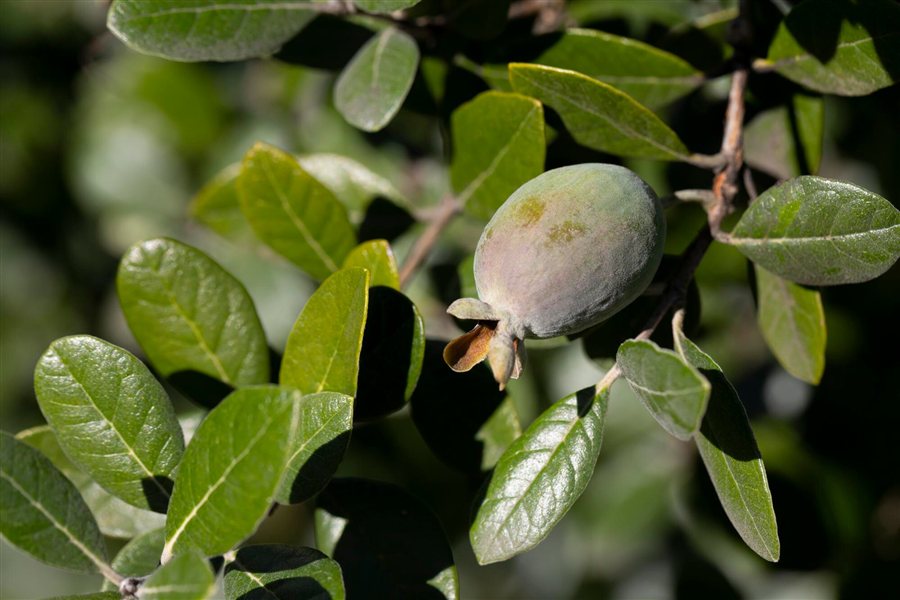
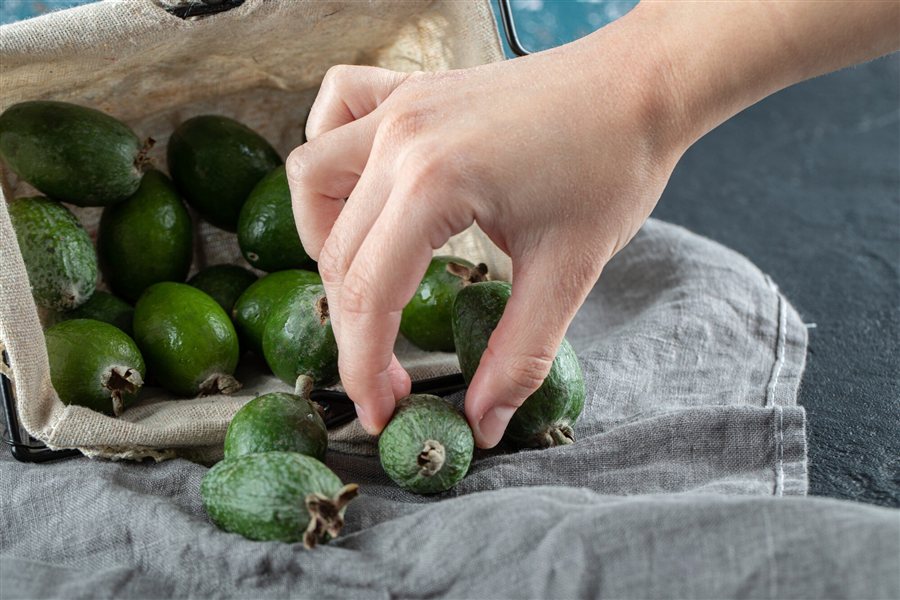
A feijoa (pronounced fee-JOH-uh, as it is in New Zealand) is an oval, egg-sized green fruit with a thin, slightly bumpy skin and a sweet-tart, tropical flavour that’s often described as a cross between pineapple, guava, and strawberry. Its botanical name is Acca sellowiana (you’ll also see the older synonym Feijoa sellowiana), and it’s a member of the myrtle family, the same broader family as guava and eucalyptus.
In the United States, you’ll most often see it sold or listed as pineapple guava, the same fruit under a different name. That naming overlap is one of the biggest sources of confusion for people encountering it for the first time: feijoa, pineapple guava, and Acca sellowiana all refer to exactly the same fruit.
Where Feijoas Come From
Feijoas originally come from the highlands of South America, including parts of Brazil, Uruguay, northern Argentina, and Paraguay. The fruit made its way to Europe in the late 1800s, and New Zealand growers introduced their first cultivars around 1908.
Over the following decades, New Zealand growers selectively bred feijoa varieties for better flavour, and the fruit became a genuine backyard staple there, so much so that most New Zealand households with a garden either have a tree or know someone dropping off a bagful every autumn. New Zealand’s Bay of Plenty and Waikato regions, with their volcanic soils and temperate climate, are well suited to growing feijoas.
What Does a Feijoa Taste Like, and How Do You Eat One?
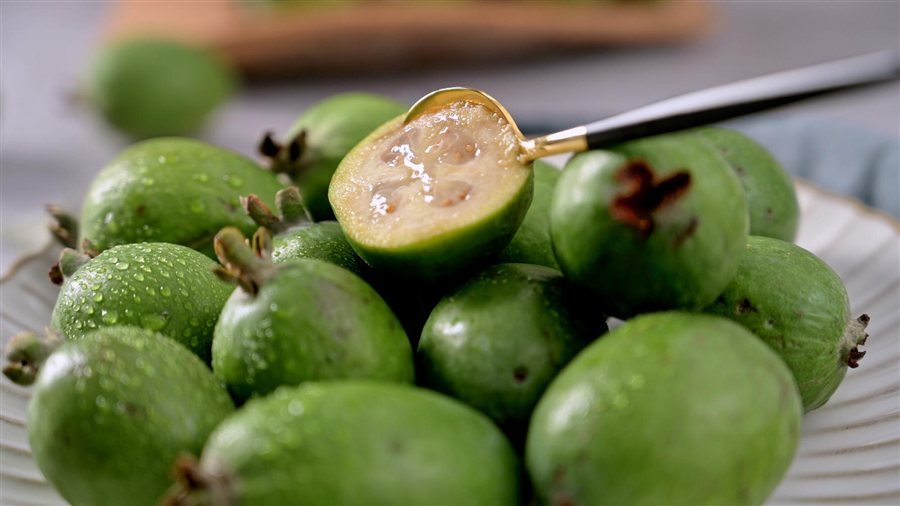
A ripe feijoa has a distinct aroma and a sweet-tart flavour that’s hard to pin to just one comparison, though pineapple, guava, and strawberry all come up often.
The simplest way to eat one: cut it in half and scoop out the flesh with a spoon, much like a kiwifruit or a small avocado. The skin is edible, though not everyone enjoys it, so it is usually left behind. A ripe feijoa should give slightly to gentle pressure, similar to a ripe avocado or peach; an unripe one will be hard and much less fragrant.
Growing Your Own Feijoa Tree
Feijoa trees are evergreen shrubs that suit a temperate climate reasonably well, tolerating light frost once established, which is part of why they’ve thrived in New Zealand gardens far beyond commercial orchards. They prefer full sun to light shade and well-drained soil, and trees need reasonable moisture over summer.
Many feijoa varieties set some fruit on their own, but a second, different variety nearby usually gives heavier crops and larger fruit, so it’s worth checking which type you’re planting if you want a reliable harvest. Fruit typically ripens in autumn, with harvest running roughly April to June in New Zealand, several months after the tree’s distinctive red-and-white flowers appear in late spring (November to December). Fruit is best left to drop naturally when mature.
Feijoa Nutrition at a Glance
Feijoas are naturally rich in dietary fibre, vitamin C, and polyphenols, the plant compounds behind a lot of fruits’ and vegetables’ antioxidant reputation. In one published analysis, the peel was higher than the pulp in both vitamin C (95 vs 51.8 mg/100 g fresh weight) and total phenolics (515 mg GAE/100 g), which is part of why whole-fruit preparations make use of more of the fruit than juice alone.
That same natural richness in fibre and polyphenols is exactly why feijoa has recently caught the attention of nutrition science beyond the backyard. New Zealand-grown feijoa is now the basis of Feiolix®, a whole-fruit ingredient being studied for metabolic health support. If you’re a product developer or formulator curious about the ingredient side of the story rather than the backyard side, the science behind Feiolix is a good next stop.
Frequently Asked Questions
How do you pronounce feijoa?
Most commonly “fee-JOH-uh” in New Zealand, though you’ll also hear “fay-ZHOH-uh” and “fay-HOH-uh.” The name comes from Joao da Silva Feijo, a Portuguese naturalist the genus was named after, and pronunciation varies a fair bit by region.
Is a feijoa the same thing as a pineapple guava?
Yes. Feijoa and pineapple guava are two common names for the exact same fruit, Acca sellowiana. Feijoa is the more common name in New Zealand and much of the rest of the world; pineapple guava is more common in the United States.
When are feijoas in season?
In New Zealand and other Southern Hemisphere growing regions, feijoa season runs through autumn (harvest roughly April to June). In the Northern Hemisphere, where the tree is also grown, the equivalent season falls in the autumn months there instead.
Can you eat feijoa skin?
Yes, the skin is edible, though not everyone enjoys it, so most people cut the fruit in half and scoop out the inside with a spoon instead.